To be successful, a new business must have a solid plan, make good choices, and have access to the necessary resources. There are many areas where startups encounter issues with respect to customer service, marketing, sales, accounting, and general management of day-to-day operations. When a startup does not utilize appropriate tools or strategies to handle each of those responsibilities, they will find that responsibility very challenging.
Growth Navigate is an important framework for entrepreneurs and startups to enhance their business processes and realize sustainable growth over time. Growth Navigate utilizes advanced technologies, productivity software, and efficient business practices to simplify tasks and organize work.
Startups today need more than just great ideas to be successful. To be successful, startups must use the proper software, hire a talented group of employees, and have a good idea who they are selling to. If a startup chooses the right digital tools, it will help them save time, build better relationships with customers, and find other ways to grow.
What Is Growth Navigate?
Growth Navigate is the act of recognizing potential growth opportunities for a company and applying relevant methods and technology-based tools to enable the company to grow sustainably. This process enables startups to recognize where technology will assist in improving various aspects of their operation.
To illustrate this point, businesses may utilize Customer Relationship Management (CRM) software to track and organize their customers’ data; Automation Tools to decrease the amount of routine tasks that need to be performed; and Analytics Platforms to gain insight into how their customers behave.
The primary goal is to provide entrepreneurs with the information they need to make wise choices, and create a solid basis for their businesses.
Some important objectives include:
- Improving business productivity.
- Managing customer relationships.
- Identifying new business opportunities.
- Improving team collaboration.
- Reducing repetitive tasks.
- Tracking business performance.
- Supporting long-term expansion.
Best Growth Navigate Tools for Startups
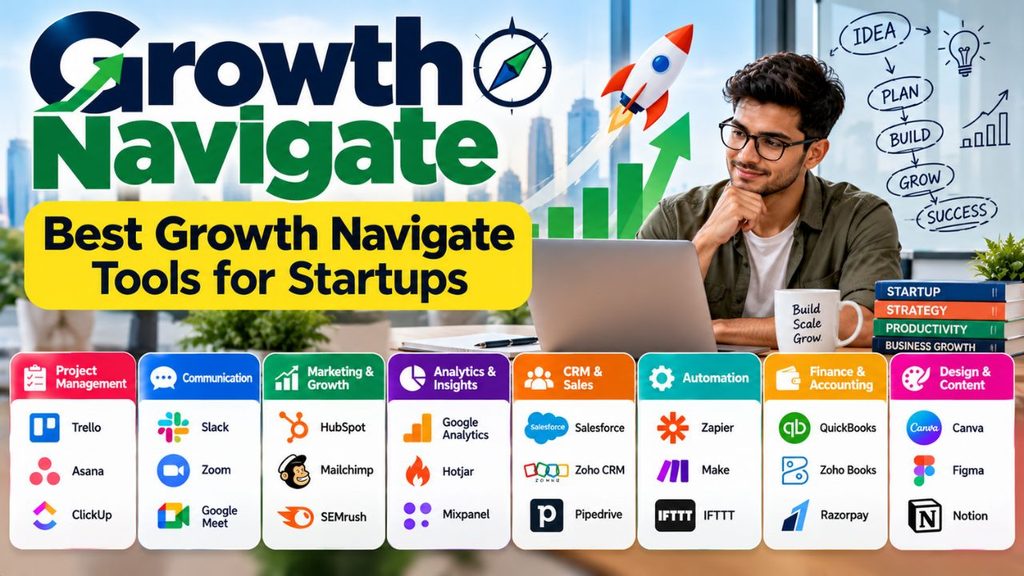
Digital tools are essential to the growth of today’s businesses. New companies have access to many types of software that will allow them to perform daily functions and improve their entire operation.
HubSpot CRM
HubSpot CRM is a common CRM (customer relationship management) system used by companies to track their leads, customers, and sales activities.
Start-ups can utilize this tool to keep track of their customer data, identify sales opportunities, and communicate with potential clients.
Its important features include:
- Contact management.
- Sales pipeline tracking.
- Marketing automation.
- Customer communication.
- Performance reporting.
This is an excellent option for organizations who wish to enhance their sales processes and develop stronger relationships with customers.
Attio
Attio is an innovative CRM platform that enables businesses to create and maintain their customer relationships while also managing all aspects of their customer’s data.
Teams can create customized workspaces to manage their contacts, monitor business opportunities and coordinate their sales efforts.
This system has several key characteristics, including tracking relationships, managing contacts, automating workflows, and integrating emails.
Attio provides an adaptable option for growing startup companies to handle their business associations.
Crunchbase
Crunchbase is an online business research tool that allows users to find information on companies, investors, funding activities, and other industry trends.
Entrepreneurs can utilize this resource for researching competitors, identifying prospective investors, and understanding the trends in their markets.
Some useful features include:
- Company research.
- Investor information.
- Funding details.
- Competitor analysis.
- Industry insights.
This will allow startups to make more informed business decisions based on research and market data.
PostHog
PostHog is an analytics tool for products that allows companies to see how customers use their website and application.
Startups may also utilize this tool to determine which parts of their website are most used by users, examine user behavior on the site, and find out at what point users exit the website.
Product analytics, session recordings, conversion funnels, A/B testing, and feature management are some of its capabilities.
This information can be used by organizations to make improvements to both the digital products they provide and the customers’ experience with those products.
Amplitude
Amplitude is a second analytics solution which assists organizations with understanding how their customers interact with products, as well as the overall success of those products.
Companies can analyze how customers move through the process of buying a product, determine how much they interact with the product and find ways to enhance the value of the product.
The primary features include user interaction monitoring, consumer path assessment, retention evaluation, and funnel analysis.
This tool would be especially helpful for start-up tech businesses that wish to base their decisions on data.
Zapier
Zapier is an application-integration software program designed to assist businesses with automating repetitive tasks.
For instance, when an individual completes a form on a site, Zapier may automatically send the data to a Customer Relationship Management (CRM) program.
Its main features include:
- Workflow automation.
- Application integrations.
- Automated notifications.
- Data transfer.
- Multi-step workflows.
The use of automation will allow smaller groups to be able to better utilize their time and allow for concentration on other aspects of the business.
Closely
Closely is a sales prospecting and outreach tool which enables businesses to find possible clients as well as organize their business communications.
Startups can utilize this tool to plan and implement sales outreach campaigns, find appropriate prospective customers, and generate more leads.
Its capabilities include building leads, sending out emails to potential customers, creating messages that are tailored to each individual customer’s needs and interests, and managing your advertising campaigns.
This will help businesses who wish to grow their professional network and develop additional business development possibilities.
Notion
Notion is an application for managing projects, creating documents, and tracking your everyday tasks as a team.
Startups may utilize this tool to compile notes from meetings, structure their organizational knowledge, develop plans for projects, and designate roles.
Its main features include:
Project management.
- Task organization.
- Team collaboration.
- Document management.
- Knowledge sharing.
Employees are able to better manage their tasks with a single location for organizing their work.
Comparison of the Best Startup Tools
| Tool Name | Main Purpose | Best For |
| HubSpot CRM | Customer management | Sales teams |
| Attio | Relationship management | Growing businesses |
| Crunchbase | Market research | Entrepreneurs |
| PostHog | Product analytics | Technology startups |
| Amplitude | Customer behaviour | Product teams |
| Zapier | Workflow automation | Small businesses |
| Closely | Sales outreach | Lead generation |
| Notion | Team collaboration | Startup teams |
How to Choose the Right Growth Navigate Tools?
Selecting the best software is crucial for all startups. Startups need to know what they require before buying any platform and evaluate which of the available choices will meet those needs.
Understand Your Business Needs
The first step in improving your business is to determine which aspects of your business need attention. An example of this would be if you find that it’s challenging to manage your customers’ information, then a Customer Relationship Management (CRM) system would likely be beneficial. If your employees are spending too much time performing repetitive tasks, then automated software would most likely be a better option for you.
Check Your Budget
As a result of their restricted budget, many start-ups use free software as opposed to paid subscriptions. Before making a decision on what software you want to utilize for your business, take some time to compare free options, subscription rates, and the available features of each.
Look for Easy Integration
Choose the tool(s) that will integrate well with your present application(s). Integrating properly with other applications will help decrease manual tasks, as well as make managing data easier.
Consider User Experience
Employees should have an easier time understanding and using the software they are assigned. Difficult-to-use platforms can cause additional problems and lower employee productivity.
Think About Future Growth
Pick a solution that is able to grow with you as your business grows by supporting an ever-growing number of customers, employees, and everyday activity.
Benefits of Using Growth Navigate Strategies
Using appropriate business tools and strategies can provide several advantages.
| Benefits | Explanation |
| Better Productivity | Helps employees complete tasks efficiently |
| Time Management | Reduces repetitive manual activities |
| Customer Satisfaction | Improves customer communication |
| Better Decisions | Provides useful business information |
| Team Collaboration | Improves coordination between employees |
| Cost Management | Helps control unnecessary expenses |
| Business Expansion | Supports increasing business requirements |
These benefits can help startups create an organized working environment and improve their overall performance.
Common Mistakes Startups Should Avoid
Technology has the potential to simplify business processes, however choosing the wrong tool may produce new difficulties.
Here are some common mistakes entrepreneurs should avoid:
Purchase of numerous software programs with no clear idea what each does, increases the cost of doing business.
Employee Training Not Done: Before employees use new software, they need appropriate training.
Not evaluating how well the selected tool works: Organizations need to frequently check if the chosen tool provides value.
Not prioritizing data security: Protecting your customers’ and company’s data should always be a top concern.
: Business decisions rely heavily on human judgment and oversight.
Start-ups should start using only those applications that are necessary and then progressively add other solutions as needed.
How Growth Navigate Helps Businesses Achieve Long-Term Success
Business expansion is based on ongoing enhancements and effective administration. Business owners should know who their clients are, keep track of industry shifts, and create plans which align with their company’s goals.
The purpose of Growth Navigate is to help startups find ways to use technology in a smart manner. Startups do not need to purchase all the different types of software out there, but rather they can choose the software that is most relevant to their needs and helps them address their issues.
A few examples of technology being used to help businesses grow include: -CRM Software to better manage customers -Analytics Tools to learn more about how customers use products/services -Automation Platforms to eliminate manual steps.
In addition to this, project management tools allow for better communication among staff members, which in turn helps teams finish their projects within the desired time frame.
Combining the above solutions with the use of appropriate planning and a skilled workforce can provide a more solid basis for your company.
However, software is not enough to ensure a company’s success. Companies will need to develop quality products and satisfy their customers. They will also need to engage in financial planning and continue making consistent efforts.
Conclusion
To build a successful startup, entrepreneurs should plan properly, use effective management practices, and have the appropriate digital tools. There are many areas of business that entrepreneurs must manage such as customer relations, sales, marketing, research, and collaborative teamwork.
Growth Navigate provides an effective means of identifying ways in which contemporary technology and business approaches will help start-ups grow.
Using tools such as HubSpot CRM, Attio, Crunchbase, PostHog, Amplitude, Zapier, Closely and Notion can make business processes more efficient.
The most effective strategy to help you meet your business goals is to determine what you need from your company, find the best products to provide those services, and then constantly make adjustments. By using the proper strategies, technology, and consistently working towards meeting your objectives, startups can increase efficiency, create long-lasting connections with their customers, and create lasting success for their companies.
Frequently Asked Questions (FAQs)
1. What is Growth Navigate?
Growth Navigate is a business growth approach that focuses on using modern technology, digital tools, and effective strategies to help startups improve productivity and achieve long-term success.
2. Which tools are useful for startup growth?
Some useful startup tools include HubSpot CRM, Attio, Crunchbase, PostHog, Amplitude, Zapier, and Notion. These platforms help with customer management, analytics, automation, and team collaboration.
3. How can Growth Navigate help small businesses?
Growth Navigate can help small businesses improve daily operations, manage customers, reduce repetitive tasks, track performance, and identify new business opportunities.
4. Are startup growth tools suitable for beginners?
Yes, many startup tools offer beginner-friendly interfaces, free plans, and simple features. Small businesses can start with basic features and upgrade as their requirements increase.
5. Why is technology important for startup growth?
Technology helps startups save time, improve communication, understand customer behaviour, automate routine activities, and make better business decisions.
Also Read: Aparna Mukerjee Biography | Yogesh Rawat Age | Disha Parmar Biography